In the quiet solitude of my cramped apartment, the weight of two decades pressed on me like an invisible storm. The peeling paint on the walls and the faint hum of the air conditioning did little to distract from the gnawing ache that had grown in my chest over the years.
For twenty years, I had lived in service to my family, placing their happiness above my own, assuming every promise, every excuse, every lie, was truth.
I had believed love would always be reciprocal, that loyalty would be met with honesty. But life had a cruel way of teaching lessons we weren’t prepared to absorb.
Tonight, though, the fog of disbelief and hurt that had long clouded my mind began to lift. The betrayal that had seemed insurmountable became tangible, something I could examine, dissect, and finally confront.
I sank into the worn armchair by the window, laptop perched on my knees, and began methodically untangling the web my family had woven over me.
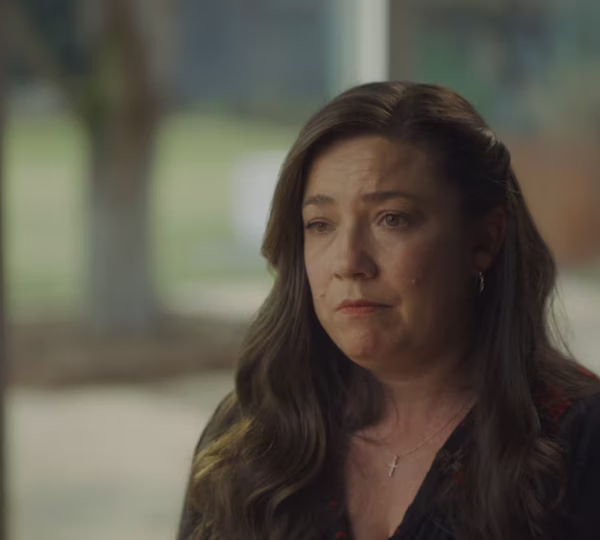
Every shared account, every transferred sum, every investment that had supposedly “benefited the family” was scrutinized. I had the evidence; now, it was time to wield it.
I began by cataloging the financial records, a task both meticulous and excruciating. Twenty years of transactions—wire transfers, credit statements, investment portfolios—sprawled across the screen like a map of deception.
My fingers flew over the keyboard, double-checking, cross-referencing, annotating each irregularity with clinical precision. Each anomaly, each misused dollar, felt like reclaiming a piece of myself.
The money had been just one facet of the betrayal, but it was tangible proof, a testament to the manipulation and deceit that had defined so much of my adult life.
Once the documentation was complete, I turned my attention to the network I had built over the years. Friends and colleagues in law enforcement, journalism, and finance became my allies, each ready to assist in a storm that had been years in the making.
Phone calls stretched into the early hours, hushed conversations blending into the hum of the city outside. I had imagined this moment countless times—its emotional intensity, its moral reckoning—but the reality was sharper, more vivid than I had anticipated. Every call I made, every document I sent, tightened the knot of justice that was about to unravel the façade.
By the time the first hints of dawn bled through my grimy blinds, the files were ready. Carefully compiled, meticulously labeled, and undeniable in their clarity, they contained a chronology of manipulation, deceit, and betrayal.
I paused for a moment, staring at the glowing screen, and realized that this act, while aggressive and unflinching, was not born of vengeance alone.
It was an act of reclamation, a statement that I would no longer be defined by their deception. With a deep, deliberate breath, I clicked “Send” on the email that would carry these revelations to the authorities and the press.

The response was almost instantaneous. Bank accounts were frozen, assets seized, and subpoenas issued. The world I had once believed in—the life my family projected as secure and prosperous—fractured before my eyes.
Social media, once dominated by curated displays of extravagance, went silent. The lavish mansion, a symbol of status and pretense, now stood empty, a hollow monument to greed and falsehood.
For the first time, the consequences of their actions became publicly visible, and with it, a strange satisfaction coursed through me. I had become both observer and architect of accountability.
In the days that followed, the fallout expanded beyond what I could have imagined. News outlets reported on the story, framing it as both a cautionary tale and a human drama.
Friends, colleagues, and even distant acquaintances reached out with support and astonishment, acknowledging not only the audacity of the act but the courage required to execute it. Through this tumult, I began to recognize the magnitude of what had transpired.
I had taken control of my narrative, transforming years of silent suffering into a declaration of agency. The very thing that had been my weakness—blind loyalty—had become my instrument of empowerment.
Yet the journey was not without complexity. Even as justice unfolded, I wrestled with a cascade of emotions. Anger mingled with grief, and relief danced with lingering sorrow.
The recognition of my family’s betrayal was painful, but it was also illuminating. I understood, with stark clarity, that their actions had been the product of years of unchecked ambition, entitlement, and moral compromise.
Their world had been built on the exploitation of my trust, yet I realized that their collapse did not diminish my past sacrifices. Instead, it reframed them as the groundwork for my resilience.
During these weeks, I spent long hours reflecting on the nature of trust, loyalty, and familial bonds. What had begun as simple faith in my loved ones had grown into a network of enabling lies and exploitation.
And yet, I recognized the paradox: without that trust, I would never have had the motivation or clarity to act with the precision required to dismantle their scheme. Their betrayal had inadvertently forged a strength within me that was both terrifying and liberating.

The media coverage, though intense, remained largely factual. Reports documented the frozen assets, legal proceedings, and public fallout without sensationalizing the personal narratives behind the numbers.
Journalists highlighted the cautionary aspects of the story—how even the closest relationships could conceal profound deception—and framed my actions as a case study in accountability and justice. For the first time in decades, the story of my life was not being dictated by those who sought to exploit me, but by the truth I had assembled.
Meanwhile, the public response was a mixture of shock and admiration. Social media, often a fickle mirror, buzzed with commentary on the courage required to confront such betrayal.
Many shared personal anecdotes of their own experiences with deception, expressing solidarity and support. Others debated the ethical dimensions, questioning whether exposing familial misdeeds so publicly was justifiable. To me, the answer was clear: there is no morality in silence when injustice thrives unchecked.
Even as the world watched the unraveling of my family’s empire, I focused on the quieter victories—the personal reclamation of dignity, autonomy, and self-respect.
For decades, I had defined myself by my role within the family, subsuming my needs and desires to maintain the illusion of harmony.
That illusion had shattered, leaving me raw but also unburdened. I began to envision a life constructed entirely on my own terms, a future in which trust would be earned, not assumed, and where love would not serve as a weapon.
The process of rebuilding was gradual. I revisited relationships with old friends and colleagues, some of whom had distanced themselves out of necessity, others out of discomfort.
Reconnecting allowed me to establish a renewed sense of community, one grounded in mutual respect rather than obligation.

Simultaneously, I began revisiting personal ambitions long deferred—traveling, creative projects, and professional opportunities that had been sidelined for the sake of family loyalty. With each step, the reclamation of self became more tangible, more real.
One of the most profound lessons was the recognition that betrayal, while intensely painful, need not define one’s identity. I realized that my worth was not contingent upon the trustworthiness of others, but upon the integrity with which I approached my own actions.
This insight reshaped my understanding of relationships, boundaries, and the essence of personal sovereignty. Whereas once I had measured my success by the satisfaction of those around me, I now measured it by my ability to act authentically, with courage and clarity.
As the legal and financial consequences for my family continued to unfold, I began documenting the experience. Initially a personal journal, this record evolved into something larger—a framework for understanding betrayal, resilience, and accountability.
I explored not only the tangible details of the financial fallout but the psychological and emotional dimensions as well. By framing the narrative in both practical and reflective terms, I sought to create a resource that might guide others facing similar challenges, whether in family dynamics, corporate fraud, or personal relationships.
In moments of reflection, I also confronted lingering guilt and regret. Despite their deception, these were my family members, and the bond we shared, however compromised, had once been genuine.
I allowed myself to grieve the loss of that innocence, the years spent in servitude and unknowing complicity. Mourning, I discovered, was not a weakness but a necessary step toward emotional clarity and liberation.
Over time, the initial adrenaline and urgency of action gave way to a more sustained, deliberate approach to life. I cultivated mindfulness, grounding myself in the present rather than dwelling solely on past betrayals.
I explored new routines, developed healthier patterns of self-care, and began engaging in mentorship and volunteer work, translating personal pain into meaningful contributions to others.
In doing so, I discovered an expansive sense of purpose, one not contingent upon familial validation or material gain.
While some might view my actions as retribution, I understood them differently. This was not revenge; it was restoration—a methodical and necessary reclaiming of agency. By exposing deceit, protecting my own resources, and asserting boundaries, I had reclaimed the narrative of my life.
The freedom I now experienced was both tangible and emotional, providing a foundation for the next chapter of existence.
Even as public attention waned, the internal transformation persisted. No longer constrained by the manipulation and control that had defined my earlier years, I embraced opportunities for growth, creativity, and connection with others.
Friendships deepened, professional collaborations flourished, and I began exploring avenues of personal enrichment previously inaccessible due to the weight of obligation.
Every step reinforced the realization that resilience is not merely enduring hardship but emerging from it with clarity, self-respect, and purpose.
In the evenings, I often revisited the apartment where it all began, noting the contrast between the silent rooms and the vibrant possibilities of the outside world.
These moments were meditative, offering both reflection and inspiration. The apartment, once a sanctuary of despair and contemplation, became a symbol of rebirth—a place where past mistakes could be acknowledged but no longer dictated the trajectory of life.
Ultimately, I understood that betrayal, while devastating, can catalyze profound personal growth. By confronting the deceptions of my family, I gained more than restitution;
I discovered my own capacity for courage, discernment, and independent action. Trust, I realized, is sacred and must be cultivated carefully, but its absence does not preclude fulfillment or self-realization.
As months turned into years, the lessons endured. I rebuilt not only my financial stability but my self-perception, cultivating confidence in decisions both large and small. I navigated relationships with a renewed sense of discernment, balancing openness with caution.
Most importantly, I internalized a truth that had eluded me for decades: that love and loyalty are not guarantees of protection, but acts of choice, responsibility, and alignment with integrity.
The narrative of my life, once dictated by manipulation and falsehood, had been rewritten through decisive action, critical analysis, and unwavering moral clarity. I had faced betrayal, confronted deception, and emerged not broken but resolute.
In that emergence, I discovered a freedom deeper than any material reward—a freedom to act, to create, and to love on my own terms.
Standing at the threshold of a new chapter, I embraced the unknown with confidence. Opportunities to rebuild, explore, and cultivate meaningful relationships abounded. With each sunrise, I reaffirmed the lessons of the past while committing to a life guided by authenticity, courage, and self-respect.
The future was no longer a reflection of past betrayals but a canvas of possibility, shaped by my actions, my choices, and my resolve.
In reclaiming my story, I had transformed the pain of betrayal into a testament of human resilience. I had turned silence into voice, passivity into action, and despair into empowerment.
And in doing so, I realized the ultimate truth: that while we cannot always control the actions of others, we can always reclaim control of ourselves.
And so, I moved forward—not with vengeance, but with clarity; not with bitterness, but with conviction; not with fear, but with an unshakable sense of self.
My life, once dictated by betrayal, was now a testament to the enduring power of truth, integrity, and the courage to confront even the deepest wounds.
The storm had passed, and in its wake, I found not only freedom but the possibility of joy, growth, and self-realization.