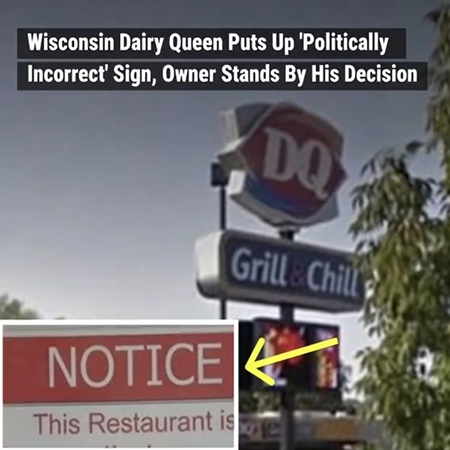
We are republishing this story, which originally made headlines in September 2017, after a small Dairy Queen franchise in Kewaskum, Wisconsin.
Became the center of national attention due to a simple but provocative sign in its front window. While many expected a story about ice cream and sundaes.
What unfolded was a discussion about free speech, business values, and cultural perception in modern America.
The Viral Sign
The sign, prominently displayed in the restaurant’s front window, quickly drew the eye of passersby and soon the scrutiny of people across the country.
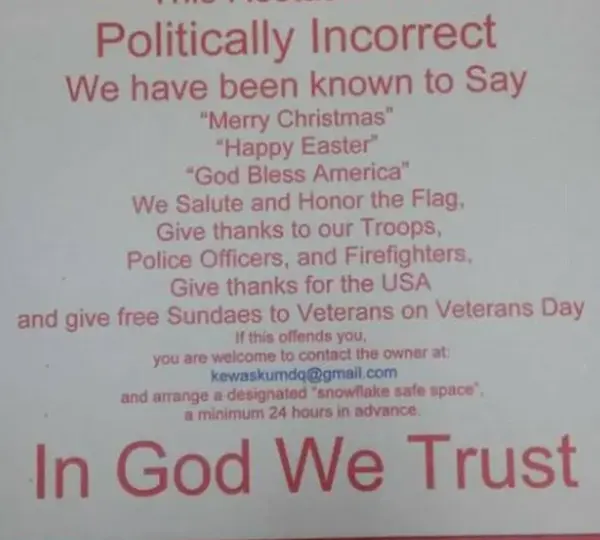
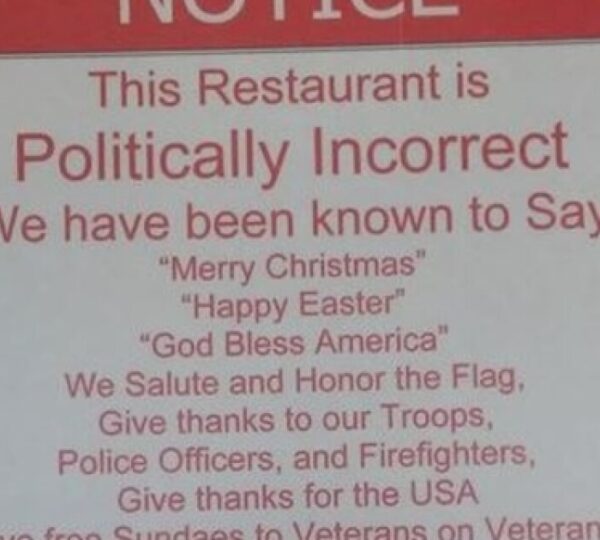
Its message was bold and straightforward. It described the Dairy Queen as “politically incorrect”, and stated that the staff say “Merry Christmas,” “Happy Easter,” and “God Bless America.”
The sign also emphasized the restaurant’s respect for patriotic traditions, noting that the business salutes the flag, supports the troops, and offers free sundaes to military veterans on Veterans Day.
According to reporting by WDJT, the sign was intended to communicate the personal and professional values of the franchise owner and his staff — not to attack or alienate anyone, but rather to be transparent about the ethos they maintained in the restaurant. However, what was intended as transparency quickly became a viral sensation.
The Owner’s Intentions
Franchise owner Kevin Scheunemann explained that he had posted the sign years before it gained national attention, originally in response to a customer complaint about the restaurant playing Christian music.
“It just seems that those kinds of values and principles are becoming controversial in society,” Scheunemann said.
His intention was simple: let customers know what to expect in the environment of his business.
Scheunemann first put up the sign nearly four years earlier, emphasizing that it was not meant to be provocative but was instead a declaration of the core principles he and his staff followed in daily operations.
“We’re not trying to be offensive,” he explained in interviews. “We just want people to know what we stand for, and to feel welcome if they share those values.”
According to Scheunemann, after the initial posting, there were no further complaints and the sign did not generate any significant local controversy — until an image of it was shared online by a visitor from Oregon.
That single post on Facebook brought the Kewaskum Dairy Queen into the national spotlight almost overnight.
The Social Media Reaction
Once the photograph circulated online, reactions were swift, intense, and varied. Many social media users expressed concern or disapproval of the sign’s language and implications, sparking heated discussions about the role of political correctness, religion, and patriotism in public-facing businesses.
According to reporting from KIRO, the Facebook post that initiated the controversy was eventually deleted, but not before it had already inspired widespread debate.
Some critics argued that labeling a business as “politically incorrect” was inherently exclusionary or provocative, suggesting that the messaging could alienate customers who did not share the same cultural or religious values.
Others pointed to the explicit references to Christian holidays and patriotic sentiment, interpreting the sign as a deliberate statement against inclusion or diversity.
Conversely, many commenters defended Scheunemann, emphasizing the right of independent business owners to express personal values while maintaining the right for customers to choose whether or not to patronize the establishment.
“You don’t have to walk in if you don’t agree with it,” said April Serwe, a local bar owner and community resident, echoing a sentiment shared by many in Kewaskum.
Local Community Support
Despite the attention on social media, local reactions in Kewaskum were largely supportive. Residents and fellow business owners highlighted the importance of consumer choice in a free-market system.
Many noted that Scheunemann had not used the sign to attack anyone, but simply to convey the environment customers could expect.
The discussion touched on broader cultural themes, including freedom of expression, religious expression in business, and respect for military service.
While the sign became a national talking point, in Kewaskum, it was seen largely as an extension of community values, reflecting a small-town perspective where such messaging was commonplace and not intended to provoke controversy.
Corporate Clarification
Following the viral attention, Dairy Queen’s corporate office issued a statement to clarify the situation.
The statement emphasized that the sign reflected only the views of the independent franchise owner, not the company as a whole.
Dairy Queen reminded the public that all customers should be treated with dignity and respect, regardless of their personal beliefs or background.
Corporate officials underscored that while independent franchisees have latitude in how they operate their businesses, the chain as a whole does not endorse political messaging or the promotion of specific religious beliefs in its locations.
This distinction helped clarify that the controversy stemmed from individual expression rather than official corporate policy.
The National Conversation
The Kewaskum Dairy Queen sign became a flashpoint in a broader discussion about political correctness, freedom of speech, and cultural values in American society.
Across the country, media outlets covered the story, some framing it as an example of cultural polarization, others highlighting it as a case study in personal expression and business autonomy.
The debate revealed several recurring themes:
Freedom of Expression vs. Public Sensitivity – The incident highlighted how personal or religious values expressed publicly by businesses can be both defended and criticized, depending on cultural context.
Role of Social Media – The viral nature of the post illustrated the power of social media to amplify local issues to national attention, often magnifying controversy beyond the original intent.
Consumer Choice – Local supporters emphasized that the free-market system allows consumers to make choices aligned with their values, reinforcing the idea that businesses are accountable to their customers without mandatory conformity to national trends.
Separation Between Franchise and Corporate Policy – The distinction between corporate policy and independent franchise owner decisions became a key talking point, reinforcing that large chains may not endorse all messages displayed by franchisees.
Owner’s Perspective: Transparency and Integrity
Scheunemann maintained that the sign was intended to foster transparency, not controversy.
He argued that modern society has grown sensitive to expressions of faith, patriotism, and personal principle, and he wanted to communicate openly about the values his restaurant embodies.
In interviews, Scheunemann expressed frustration with what he saw as unnecessary attacks on his personal and professional integrity, stating that the intent of the sign was never to insult or provoke, but to clarify the type of environment customers could expect.
He explained, “We’re not asking anyone to agree with us. We’re just asking people to understand what we stand for.”
The sign also communicated tangible actions, such as offering free sundaes to military veterans on Veterans Day, which Scheunemann described as an expression of gratitude and community engagement, not a political statement.
Broader Cultural Implications
The controversy surrounding the Kewaskum Dairy Queen touches on larger societal conversations about how businesses navigate cultural and political landscapes.
In an era where messaging can reach national and international audiences instantly, even small actions — like a window sign — can become lightning rods for debate.
The discussion raises questions about:
How businesses communicate personal or local values without alienating potential customers.
The balance between free expression and inclusivity, especially in public spaces.
The role of social media in transforming local incidents into national talking points.
The responsibilities of franchisees versus corporate chains in shaping public messaging.
Scholars and commentators have suggested that the story is emblematic of a shift in American cultural discourse, where seemingly minor acts can quickly become symbolic flashpoints for debates about identity, faith, patriotism, and social norms.
The Aftermath
Following the viral attention, Scheunemann reported that most local customers remained supportive, continuing to patronize the restaurant and recognizing that the sign did not interfere with their experience.
Many expressed pride in the franchise owner for standing by his principles, even as the story drew national scrutiny.
The national debate eventually subsided, but the incident left lasting lessons for business owners, social media users, and consumers alike.
It demonstrated how quickly local actions can become national news and underscored the importance of context, transparency, and communication in preventing misunderstandings.
Conclusion: A Case Study in Values and Public Perception
The Kewaskum Dairy Queen story is not merely about a window sign or ice cream. It is a reflection of modern American society, where personal expression, community values, and digital amplification intersect in complex ways.
For Kevin Scheunemann and his staff, the sign was a statement of identity and transparency.
For critics online, it was a prompt for discussion about political correctness, inclusivity, and freedom of speech. For corporate officials, it was an opportunity to clarify the distinction between franchisee expression and corporate policy.
In the end, the incident serves as a reminder that:
Local businesses can become national symbols almost overnight in the age of social media.
Transparency and integrity in communication are essential, particularly when values are involved.
Consumers have the power to engage, critique, or support based on their personal choices.
Sensitivity and context matter when interpreting messages in public spaces.
The Kewaskum Dairy Queen will likely continue serving ice cream, sundaes, and meals to its community, but the story of its viral sign endures as a case study in values, perception, and the interplay between local action and national reaction.
It shows that even a small-town business can spark meaningful dialogue about society, culture, and the power of words in shaping public opinion.